We are going to Las Vegas!

Historic Las Vegas sign with retro tone

That’s right: following the success of previous workshops in Washington, D.C. and New York City, we are pleased to announce two new 5w ACADEMY workshops in Las Vegas!

Our first two-day workshop is a comprehensive introduction to the creation of infographics and data visualization. With a mix of theory and practice, the workshop is aimed at professionals and students interested in developing the skills to produce engaging, insightful visual storytelling with their content.

Our second workshop is an introduction to the creation of interactive data visualizations with Tableau. This workshop is aimed to anyone that wants to explore and learn the possibilities of this amazing software, and no previous experience with Tableau is necessary.

Finally, we are offering a great discount for those who take BOTH workshops. And don’t miss the early bird discount! It is valid until May 31st.

See you in las Vegas!


Teaching Infographics

5W_Academy copy

We’ll be in New York on March 24-25 with our well received workshop on principles of infographics and data visualization. How is it different, and what do our participants learn?

Infographics and data visualization have experienced significant change since we started 5W Infographics back in 2001. And certainly since we published our very first infographics, which takes us all the way to the late 80s! If you were thinking of infographics  and dataviz as a new field, you may want to think again.

Some of these changes are profound, in good and bad ways, and they are a big part of the reason why at 5W Academy (our educational branch) we think infographics and dataviz education are important precisely now.

Individuals and corporations have now access to massive public and private data sets, and new software applications allow us to visualize them. But that’s not the same as having the ability to a find relevant story behind the data, and the skill to visualize and design it efficiently.

We also see countless of unfortunate examples of infographics that are little more than empty decorative designs around a few numbers, the product of marketing departments with the only purpose of making content viral. It’s just pretty clickbait that gives a bad name to infographics. These have become so pervasive that sadly, many people think of that type of content first when they think of “infographics”, a trendy word now. But in nearly all cases they offer absolutely nothing in terms of revealing insightful patterns and trends behind numerical or special information.

Data visualization is not new. It’s actually been around us for hundred of years, and many of the principles behind it stand the pass of time. It’s good to look back at some of them.

At 5W we started working with infographics in the field of journalism, where focus and accuracy are paramount. During long years as staff members for newspapers like El Mundo (one of the European infographics pioneers) and The New York Times, or magazines such as Fortune and National Geographic, we were trained to seek first and foremost data sets and information that was both accurate and relevant to our readers. To find focus and to visualize that content in a visual way through charts, maps, and illustrated infographics that would offer new visual insights for our readers. With stiff competition for space in the news pages, you need to prove you can inform (not decorate) in a way neither the best writers or photographers can with the tools of their craft alone.

Today it often seems like the word “infographics” has been hijacked by marketers with inadequate understanding of data visualization principles and sometimes dubious or biased agendas; and often the term “data visualization” or dataviz has been appropriated by software wizards and digital designers more fascinated by the fact they can visualize large amounts of data than by how they can extract and explain a revealing story by visualizing the core message behind it. The result is cool but empty data art that tries to pass as information or incomprehensible “data dumps” that look fascinating but lacks proper editing and design basics and just confuse anyone with an honest intent of making sense of it.

The purpose of our workshop is to explain the principles that enable us to create powerful visual stories that illuminate concepts for readers in engaging ways. And to practice them hands-on. We haven’t found a workshop that looks at all the different tools of infographics and dataviz at the same time: the Do’s and Dont’s of plotting numbers and statistics with charts; geographic and thematic cartography; illustrations and pictograms; design, hierarchy and color; and exploring creativity with those tools.

In our next post we’ll look in detail at the content and schedule of the two-day workshop.

Behind the Art with James Gurney

Tyrannosaur-Gurney

A few weeks back we mentioned in this blog the job we did for Scientific American about  new species of tyrannosaurs that have been discovered in the last few years. That job included the creation of an infographic, and the art direction for the opener spread. In the later, we had the privilege of working with the great painter James Gurney, the creator of the famous Dinotopia series. He also created the impressive illustration shown above for the cover of that SA issue.

Now James has released a fascinating video showing the process of creation for both illustrations. There is a five minute version (below), and a 40 minutes HD version available here and here for purchase. James happens to be, in addition to an incredible painter, an excellent art teacher. If you are interested in painting, you should check out his YouTube channel, chock full of nicely crafted instructional videos.

GurneyOpener

Is Lego the future of infographics?

Probably not. But I just discovered these two videos by Brookings (an influential think tank in DC) that use lego bricks to illustrate the fundamental issue of inequality in the U.S. I couldn’t help thinking how apt a tool lego bricks can be to represent numerical concepts and, being a lifelong lego fan, just how beautiful they look! No, I do not think they are the future or graphics, but I’d love to see more of these!

New graphics for Politico

Screen Shot 2015-04-21 at 5.48.25 PM

One of our latest infographics packages is live online today. Politico have just published an in depth investigation on the safety of America’s oil and gas pipelines: “Pipelines blow up and people die”, by Elana Schor and Andrew Restuccia.

The data that Politico has unveiled reveals an appalling situation: just in the last 13 years pipeline incidents in the U.S. have killed 199 people and injured 799. Just last year 19 people died on pipeline-related incidents, injured 97, and caused more than $300 million in damage. The report goes on to reveal the incompetence of the Pipeline and Hazardous Material Safety Administration, the obscure agency that oversee the immense and outdated network of American oil and gas pipelines. It turns out that the PHMSA is controlled to some degree by (surprise!) the pipeline industry.

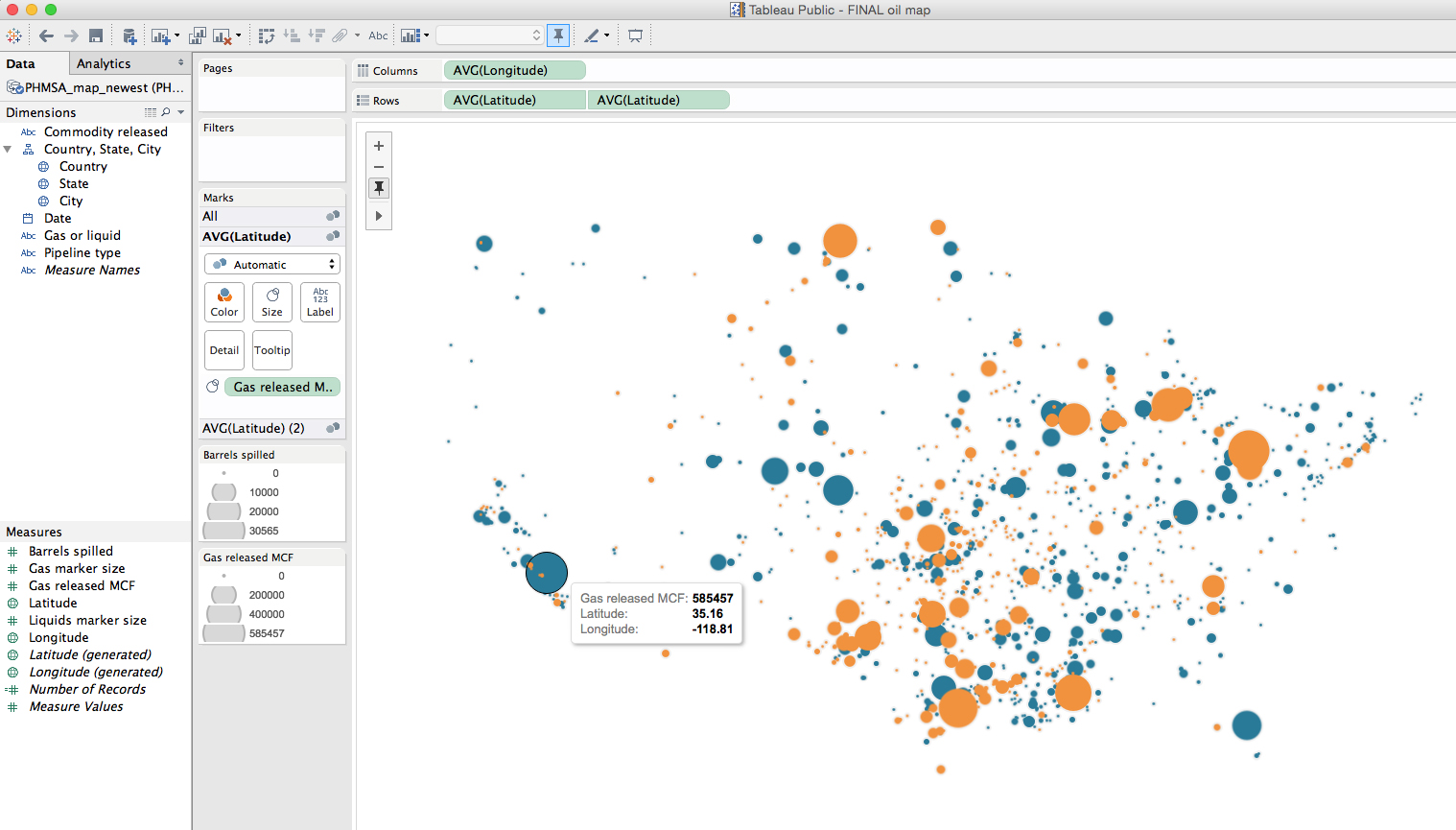
We helped Politico to visualize the very revealing data their research unveiled. The map below, created using Tableau Public and Illustrator, shows all the accidents involving oil and gas pipelines in the U.S. during the last five years.

Crime in Milwaukee 3

We are using Tableau lately to help us explore visual possibilities with large sets of data and it truly is a useful tool. Politico is not using interactivity maps and graphics yet, which would be the natural fit when using this interactive graphics tool, but we have found Tableau exports very nicely to PDF, and from there to Illustrator.

Screenshot_Pipelines_Tableau

A series of charts present various aspects of that alarming situation:

Crime in Milwaukee 3Crime in Milwaukee 3


We worked with Art Director Heather Barber and had great ideas and data sets from editor Bob King and writers Elana Schor and Andrew Restuccia.


Data Visualization with D3.js online course


Here is an opportunity you do not want to miss: Alberto Cairo and Scott Murray are co-teaching an online course called Data Visualization and Infographics with D3.js. Alberto, professor of Information Graphics and Visualization at the University of Miami, will be teaching the conceptual part or the course, and Scott, author of Interactive Data Visualization for the Web, will introduce and explain the powerful JavaScript library D3.js.

D3.js is one of the best tools to know if you are serious about interactive data visualization online (The New York Times has done amazing things with it). It is a JavaScript library designed specifically to display and control data visualization on web browsers. The learning curve can be a bit steep if you are completely new to web programming, but it is certainly worth the effort.

Reclaiming the word “Infographics”, once again

Infographic elements

Recently I rediscovered an old entry in Alberto Cairo’s blog titled “Reclaiming the word “Infographics””. It resonates strongly with my own thoughts on the matter. I have been creating infographics for 25 years now, and the word has always meant to me a blend of information, design and illustration, in which the graphic part’s (the design and the illustration) mission is to convey the information in a more illuminating and revealing way than words alone could accomplish. It is fundamentally a branch of journalism. The work that The New York Times, National Geographic, or Scientific American, among many others, are doing in this respect are prime examples of splendid infographics.

In the last few years “the term “infographics” has been hijacked”, as Cairo puts it. Instead of denoting a branch of journalism, the word is now used more and more often to refer to graphic displays that serve not journalism, but marketing. These “infographics” are often created with the (foolish) declared goal of becoming “viral” online, and, as a rule, the images are used not to convey information, but to decorate. They use graphic resources typical of the more serious, journalistic infographics, such as charts, arrows, and maps, to decorate information often chosen randomly with the only purpose to justify the presence of that very chart, arrow, or map.

You can find online thousands of “infographic elements” packs, collections of predesigned “infographic looking” graphic elements, that allow you to put together an “infographic” with minimal effort. You can (perhaps) find some information later to squeeze into your graphic. This is, almost exactly, the opposite of what I call an infographic. They represent a complete trivialization of the exacting and fascinating craft I have been practicing for many years.

RevSquare interviews us

RevSquare Interview

Our friends at RevSquare interviewed us about the state of the infographics industry, future trends, and our own personal involvement with this fascinating field. You can read the interview on their site and, while you are there, check out the amazing job these guys are doing. Thanks Rebecca! Thanks Jeff!

New Book: Infographic Designers’ Sketchbook

Heller-book-1
A few months ago I got an email from the great Steven Heller. He was preparing a new book (not really a surprise!) for his sketchbooks series. He has already published sketchbooks books for typography, graphics design, and comics. This time the book was going to be about the sketches of Infographic artists, and he would like to include some of my own, and of other members of 5W. I felt very honored. I never thought much of my own sketches, and often I get rid of them after a job is finished. But I got to work, found a few I did not dislike too much, and sent them to Steven.
 
The book, titled Infographic Designer’s Sketchbooks, by Steven Heller and Rick Landers, has just been published. It is a magnificent large tome, 350 pages long, lavishly illustrated with the most beautiful graphics and, to my surprise and delight, it dedicates six pages to us (see pictures below). It showcases  the sketches and finished work of more than 70 infographic artists from the U.S., Italy, Germany, U.K., France, The Netherlands, Ireland, Spain, Slovenia, and South Korea. It includes classics such as John Grimwade, Nigel Holmes and Massimo Vignelli. 
 
Browsing through this book is the closest thing to be inside an Infographic artist’s head. Artists sketches are the immediate, unadulterated product of the act of creation, and looking and these you can almost hear the creativity cranking up. 
 
This book will be agreat addition to your infographics book collection. 
Heller-book-2
Heller-book-3
Heller-book-4

Odd visualization: 3D crowd simulation

This is cool, fascinating, hilarious, and oddly hypnotic, all at the same time; therefore we are compelled to share it. It is a short movie created by Dave Fothergill to test a software called Miarmy. Miarmy is used, together with a 3D animation platform (Maya, in this case) to generate animated crowds (remember the zombies in World War Z?). Would’t this be useful for a visualization of the behaviors of crowds under different circumstances?