One Chart at a Time video series

Jonathan Schwabish is the author oh the PolicyViz website and host of the PolicyViz podcast, both excellent resources for anyone interested in Data Visualization. He has also just published the book Better Data Visualizations, which I just received and may review it in the near future. At first look, it’s a really outstanding guide: clear, useful and comprehensive. I’m looking forward to reading it.

To the point of this post: as a companion to the book, Schwabish is producing an interesting series of free videos in which data visualization practitioners explain different types of charts, one at a time. He asked each participant three questions:

  • Describe this chart type. What are things we should know about this particular graph?
  • What should we do and not do when creating this type of chart?
  • Can you share an example you really like?

The series, as Schwabish explains in the first video, will have 50 videos grouped in 8 categories: comparing categories, time series, distribution, geospatial, relationships, part to whole, qualitative data, and tables. A new video will be released every weekday until late March (there are 28 as of this writing). If you’d like to know more about box-and-whisker plots, histograms, streamgraphs, gantt charts, sankey diagrams and the like, take a look. It’s great initiative to help anyone interested to expand their knowledge about options to visualize different types of data, and to expand data visualization literacy in general.

Nightingale in print

Mockup of the printed version of Nightingale, Cover Giorgia Lupi, Article: Bo Plantinga.

If you haven’t had a chance to look at it, Nightingale is a fantastic resource for anyone interested in data visualization. Nithingale is the Journal (published in Medium) of the Data Visualization Society, an organization born in early 2019 to help develop a community for data visualization professionals of all backgrounds, and for anyone interested in the field. It offers an extensive wealth of articles by dozens of contributors, including career advice, “how to” and current topic articles, and a wonderful section on historic data visualizations. Although the quality varies, there is plenty of good content to be found.

The name of the publication is a tribute to Florence Nightingale (1820–1910), a pioneering British social reformer, nurse and statistician. She invented the Nightingale rose chart  (also known as Coxcomb Chart or Polar Area Diagram), which you have most likely seen around. She was the first woman to be voted into the Royal Statistical Society.

Nightingale rose chart. She  famously used it to display data on how many soldiers died in hospitals during the Crimean War (1853-1856).

Nightingale (the journal) just announced that it will begin moving into print soon. It’s an exciting development, if anything because Medium requires a paid subscription after a few free articles (it seems you can skip this by sending yourself a link in a Twitter direct message, provided you have more than one account).

In a time when everyone seems to be in the verge of abandoning print, it would be great to have a nicely printed, collectible journal specialized on data visualization . You can read more about the reasoning behind the idea in their recent article by Jason Forrest and Mary Aviles. It includes some beautiful mockups* showing what the printed Nightingale could look like.

We are wishing the Data Visualization Society good luck with this initiative!

Mockup of the printed version of Nightingale, diagram by Ladislav Sutnar, 1948

*Images from Nightingale website

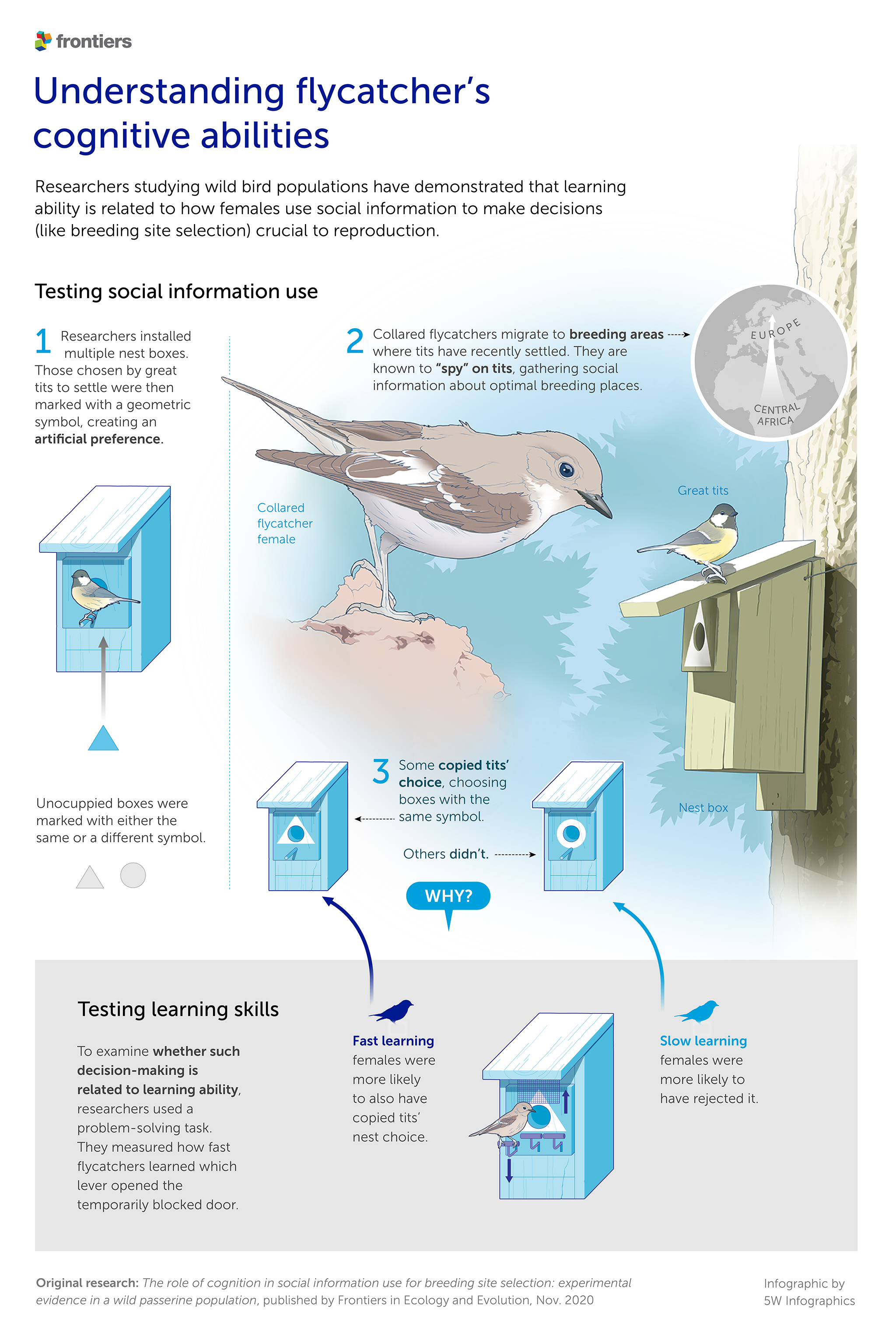
Science infographics for Frontiers

We have always enjoyed the process of working with researchers and scientists to bring their findings to large audiences. Many of my favorite moments in my previous roles at The New York Times and National Geographic were associated with pouring through research papers and working with experts in archaeology, paleontology, conservation science and so on to try to turn complexity into accessible learning.

Last month we started collaborating with Frontiers, one of the world’s leading and highest-cited publishers of peer-reviewed, open access scientific journals. Frontiers is based in Lausanne, Switzerland, and publishes 105 journals such as Frontiers in Human Neuroscience, Frontiers in Microbiology, Frontiers in Physics, and many more.

Our first couple of infographics are for the journal Frontiers in Ecology and Evolution, and highlight the findings of research papers on the cognitive abilities of birds and the risk of alpine plant extinction due to glacier retreat. The graphics were done to accompany press releases about the papers, and aim to showcase scientific findings for a general audience that would normally not encounter or read the original research papers. From the point of view of design I think they benefit from the clean and restrained color palette and abundant use of white space requested by the Frontiers Design team (props to Caroline Sutter). Here are the two graphics. Looking forward to more!